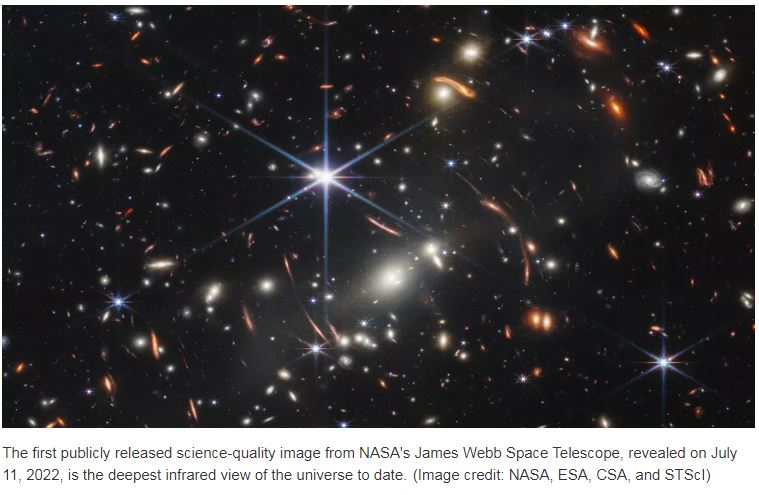
Astronomers are now discovering record-breaking distant galaxies by the dozen while sifting through the treasure trove of data now being collected by the James Webb Space Telescope (JWST or Webb). Among them are several galaxies dating back to just over 200 million years after the Big Bang.
Prior to the launch of the James Webb Space Telescope, the most distant confirmed galaxy known was GN-z11, which astronomers saw as it was about 420 million years after the Big Bang, giving it what astronomers call a redshift of 11.6. (Redshift describes how much the light coming from a galaxy has been stretched as the universe expands. The higher the redshift, the farther back in time we see a galaxy.)
Just a week after the release of the first science images from JWST, astronomers were reporting the detection of galaxies at redshift 13, equating to about 300 million years after the Big Bang. Now, a new wave of scientific results is smashing past that record, with some astronomers reporting the detection of galaxies up to a redshift of 20. If true, then we are seeing these galaxies as they existed about 200 million years after the Big Bang.
That’s a big if: At this stage, none of these redshift values are confirmed. To confirm the distances of these galaxies will require spectroscopic analysis, which splits the light from an object into what scientists call a spectrum. That analysis will come later. Nevertheless, it seems clear that JWST is fully capable of detecting galaxies from this long-lost era.
The galaxies have been detected using different techniques. Astronomers led by Haojing Yan of the University of Missouri-Columbia used the gravitational lens created by the galaxy cluster SMACS J0723 to detect 88 candidate galaxies beyond a redshift of 11, including a handful estimated to be at a redshift of 20. If validated, these galaxies would be, by far, the most distant ever detected. Because of cosmic expansion, today these galaxies would be over 35 billion light-years away from us.
Two other papers report finding high-redshift galaxies in patches of the sky where JWST has simply taken deep exposures, without resorting to gravitational lensing. These images are part of the Cosmic Evolution Early Release Science (CEERS) survey, which consists of images of 10 different patches of sky by JWST’s Near-Infrared Camera (NIRCam). JWST’s Near-Infrared Spectrograph (NIRSpec) joins in observations of six of those patches, while the space telescope’s Mid-Infrared Instrument (MIRI) studies four.
One team of astronomers, led by Ph.D. student Callum Donnan of the University of Edinburgh, found a candidate galaxy at a redshift of 16.7, which equates to just 250 million years after the Big Bang. The team also found five other galaxies with a redshift greater than 12, all of which exceed the redshift record set by JWST’s predecessor and now colleague, the Hubble Space Telescope.
Meanwhile, using the same observations from CEERS, another team led by Steven Finkelstein of the University of Texas at Austin discovered a galaxy with a redshift of 14.3, placing it 280 million years after the Big Bang, which the researchers have named “Maisie’s Galaxy” after Finkelstein’s daughter. The astronomers found that this galaxy may have also been seen by the Hubble Space Telescope, but not recognized at that time. If a closer look at the archived data does reveal the galaxy, then Maisie’s Galaxy must produce very strong ultraviolet light from a powerful burst of star formation for Hubble to have spotted it.
Indeed, all the distant galaxy candidates display evidence for strong ultraviolet light emission, enough to possibly settle the debate as to what ionized the hydrogen gas in the universe, bringing an end to the so-called “Cosmic Dark Ages.” Over the years, astronomers have suggested causes ranging from radiation from the first stars and galaxies to outflows of radiation from the first supermassive black holes.
In their paper, Donnan’s team calculate the “galaxy ultraviolet luminosity function” between redshifts of 8 and 15. This function is an average of the amount of ultraviolet light associated with galaxies at any particular epoch. The value is strongly tied to star formation, because the more hot young stars are being formed in a galaxy, the more ultraviolet light it emits. Donnan’s team concluded that there is more than enough ultraviolet radiation being produced by the stars in these early galaxies to ionize the universe.
The plethora of high-redshift galaxies being discovered can be considered cosmic babies. These galaxies span only 1,000 or so light-years across and contain just tens of millions of stars; modern galaxies can host hundreds of billions of stars. Astronomers estimate that the cosmic babies are less than 100 million years old, and possibly as young as 20 million years.
Scientists haven’t yet identified any of the very first galaxies in the universe, which may lie at redshift 25 or beyond. Still, the new detections represent generations of galaxies that followed closely after, and that scientists see in the early stages of development.
The amount of ultraviolet light (redshifted into the longer wavelengths of infrared, making it visible to JWST), coupled with the abundance of high-redshift galaxies that it is finding so early in its mission, suggests that galaxies were plentiful in the earliest history of the universe. Contrary to some expectations, the rate of star formation might decline gradually the farther back in time we look, rather than there being a sharp drop-off beyond redshift 11.
“Should follow up spectroscopy validate [these redshifts], [it means that] our universe was already aglow with galaxies less than 300 million years after the Big Bang,” Finkelstein’s team wrote in their paper.
Now that JWST has discovered these strong galaxy candidates at vast distances, the next questions are how much farther back in time JWST can see and whether it will be enough to discover the very first galaxies that existed, perhaps just 100 million years after the Big Bang. Such a discovery would require necessitate a large dose of luck, since it would rely on fortuitous gravitational lensing to bring primordial galaxies into view.
Credits: Space.com / Keith Cooper is a freelance science journalist and editor in the United Kingdom, and has a degree in physics and astrophysics from the University of Manchester.

 TCC Consultoria